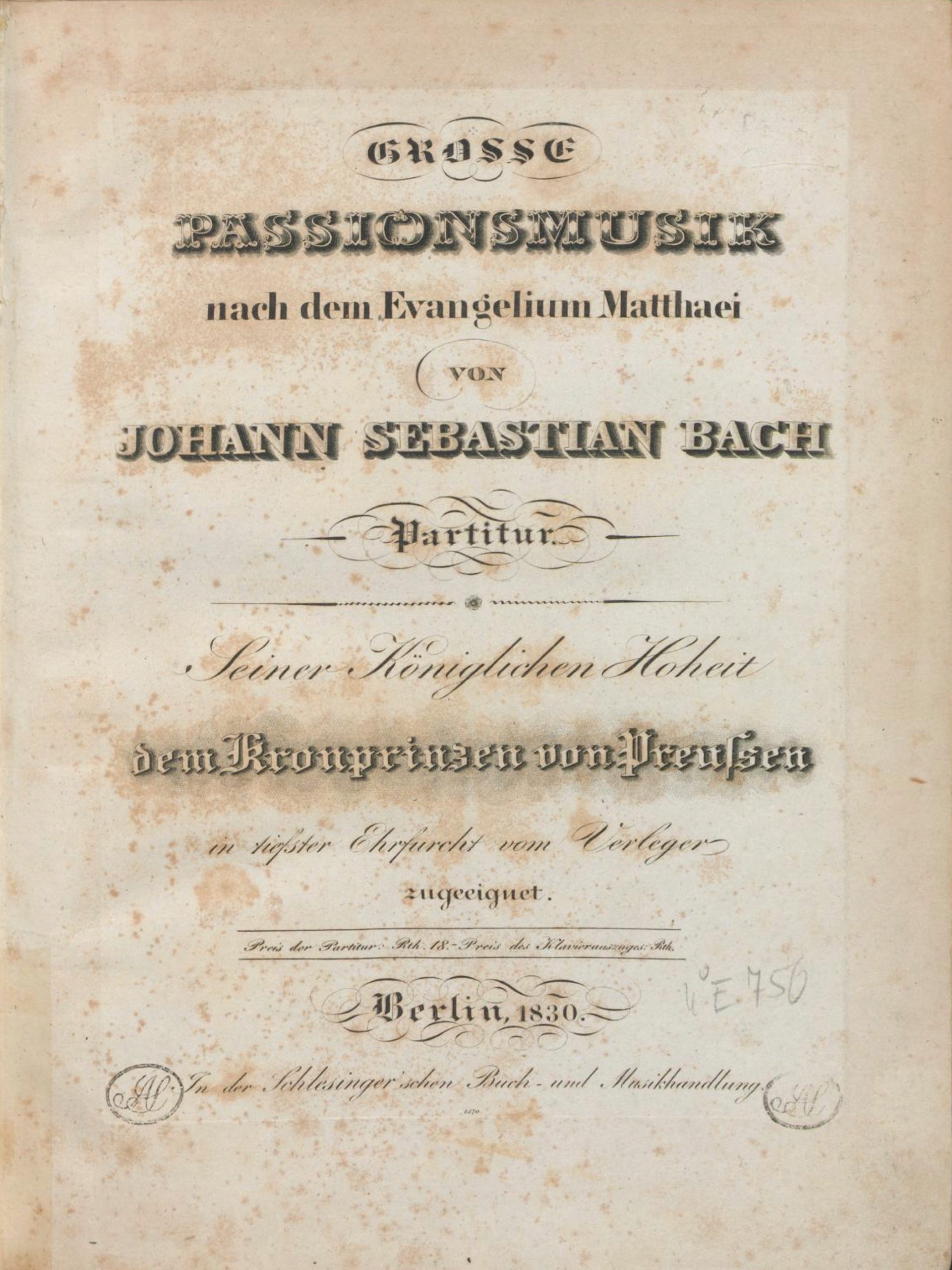
Grosse Passions-Musik : Mendelssohn meets Bach’s Matthäus-Passion
Reconstructing Bach’s Markus-Passion is like re-building a temple from the fragments of the famous Parthenon marbles. With the tantilising, yet half-complete remains of an irretrievably lost masterpiece, the reconstructor’s task thus remains – beyond careful assembly – one of suggestion: always allowing the void of incompleteness to be creative space for the beholder’s imagination to inhabit….
Bach’s Matthäus-Passion as revitalised by Mendelssohn opens up an entirely different set of parameters. Unlike the Markus the revised musical text of Mendelssohn’s Grosse-Passion was a work-in-progress, still ‘unfinished’ by the time of his death in 1847. The realisation process of such an incomplete work has the editorial challenge of following Mendelssohn’s likely train of thought while holding onto how we now view Bach’s work and performance world and its habits. It thereby adds a third layer to the final result.
Indeed Mendelssohn’s determination to revisit the Passion ushered in a new Bach era, a century after the Passion’s first performance in 1727. It was perhaps his most notable homage to Bach. It was, too, a critique on Bach’s music as a whole, music that had become in the decades since his death in 1750 largely the province of theorists and private enthusiasts. The young Mendelssohn – aged 20! – thus first mounted his first historic Matthäus-Passion in Berlin’s Sing-akademie in 1829; and then – with a dozen years to contemplate its difficulty and consider further revisions – in 1841 in Leipzig, in Bach’s own Thomas Kirche where (as Mendelssohn was to advise his brother during the rehearsals) …‘not a note of this work is known’….
Mendelssohn’s reworking of the Passion includes some pruning of arias and a smoothing out of the heightened rhetorical style of baroque recitative. The orchestra, too, is seen through Mendelssohnian eyes, with clarinets replacing extinct members of the oboe family and with a romantic re-bowing of the string parts along with the addition of a grand organ (in the manner of his own ‘Hymn of Praise’ symphony from 1840). The optional fortepiano for the secco recit takes one right into the Mendelssohnian drawing room of (this time) Lieder mit Worten!
Andrew Manze and the Royal Liverpool Philharmonic gave a pre-publication performance of the new edition in April 2023. Editorial work was finally complete some months later and the Bach Choir of Bethlehem and Bach Festival Orchestra (near Philadelphia) in the USA under Christopher Jackson gave the world premiere of the new edition in November 2023.
Recording the performance with sessions immediately following gave the luxury to capture the excitement of discovering a new Passion. And the 80-strong Bach Choir, celebrating its 125th anniversary, was the perfect Mendelssohnian choir for this premiere. Dann Coakwell took Mendelssohn’s recalibrated secco recit to heart with great care and William Sharp gave the role of Jesus a most superb elegance and espressivity.
In the summer of 2024 the Edinburgh Festival opened with Passion under Ryan Wrigglesworth and the BBC Scottish with the Edinburgh Festival Chorus in excellent form. James Grossmith, their chorusmaster, whom I had met in his student years, offered a compliment that has stayed with me: ‘thank you for this edition – without it choirs like this would never sing Bach today’. That perhaps had been my first motivation: having worked so closely with Andrew Parrott and Joshua Rifkin to understand Bach on his own terms – we would say as chamber music – how, with this intimate aesthetic as the starting point, could one test this music and its sinews! In April 2025 the Australian Romantic & Classical Orchestra give a premiere in Sydney – and this (the first that I know) on period instruments. I look forward to an opportunity to record Mendelssohn’s Grosse Passionsmusik again with nineteenth-century instruments! Versatile Bach for all time!